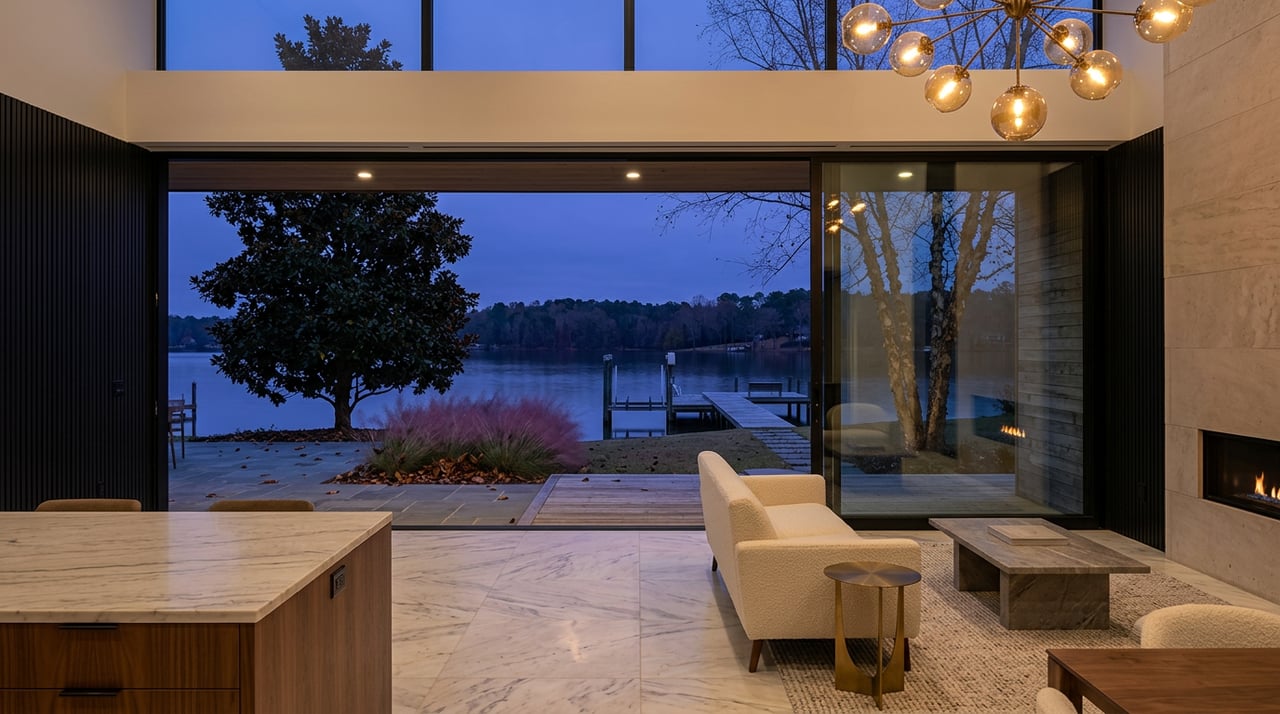
What "Waterfront" Actually Means on Lake Norman, and Why It Isn't What You Think
September 24, 2026
September 24, 2026
Most buyers assume a waterfront listing on Lake Norman comes as one package: house, yard, dock, done. Then due diligence starts, the closing attorney asks for the dock permit documentation, and the seller either produces it or doesn't. That single request is where a lot of Lake Norman transactions slow down, because the dock was never actually part of the house to begin with.
Lake Norman is a hydroelectric reservoir. Duke Energy built it, operates it under a federal license, and still owns the shoreline and the lakebed beneath the water. Your property line as a buyer ends at what's called the 760 line, the elevation the lake reaches at full pond. Everything at or below that line, including the dock sitting in the listing photos, exists on Duke's land under Duke's rules. You can own the house. You don't own the water in front of it, and you don't automatically own the right to keep, modify, or rebuild whatever is floating on it.
Here's the part that catches buyers off guard. A dock permit on Lake Norman is issued to a person, not attached to a property the way a survey or a septic permit is. When a home sells, the new owner has to formally transfer that permit into their name through Duke's Lake Access Permit System, and Duke will inspect the structure as part of that transfer to confirm it still matches what was originally approved. If it doesn't, or if the seller never got around to transferring it from a previous owner, the compliance problem becomes the buyer's problem the moment the deal closes.
Standard reviews for a private dock run four to twelve weeks. That's fine if you're planning ahead. It's a real complication if you assumed dock access would be immediate and you're now three weeks from closing with no clear answer on permit status.
Older docks add another layer. Some were built before current shoreline rules existed and carry grandfathered status, meaning they're allowed to exist even though a new dock in that same spot might not get approved today. Grandfathered status isn't permanent. If the dock is significantly modified, relocated, or damaged badly enough to need rebuilding, it can lose that protection and suddenly has to meet current standards, which are stricter on things like covered boathouses. If you're moving from a lake where covered slips are standard, reset that expectation before you fall for a listing photo. Duke's current shoreline guidelines restrict or prohibit them in many classifications.
Here's something worth knowing if you're eyeing a vacant waterfront lot with plans to build later and dock now. As of July 1, 2026, Duke Energy stopped reviewing private dock permit applications for lots where no home has been constructed yet. That change applies across every Duke Energy lake, not just Lake Norman.
Practically, that means the old strategy of securing dock rights on a bare lot before you break ground no longer works. If you're buying land with the intention of building, the dock application has to wait until there's a house on the parcel. Anyone comparing an empty waterfront lot to a home already built on the water needs to weigh that timeline difference into the decision, because it's no longer just a construction schedule question. It's now a permitting sequence you can't skip ahead of.
If you've been comparing Lake Norman to other Charlotte-area lakes using a single headline number, that number is doing you a disservice. A verified market report covering waterfront closings through the first half of 2026 put the median sale price at $1.65 million, while the average came in at $2.52 million. That's not a rounding gap. A small cluster of ultra-luxury sales, including a $12.5 million close in Huntersville, is dragging the average far above what most buyers actually pay. If you're anchoring your budget to an "average" figure you found somewhere, you're benchmarking against a market that barely exists for most people. The median is the number that reflects what a typical waterfront transaction looks like.
The town-by-town breakdown tells a more useful story than the lake-wide figure:
| Town | Waterfront activity (verified closings) | Median sale price |
|---|---|---|
| Mooresville | Carried roughly half the lake's waterfront volume | $1.465 million |
| Denver | Four closings, strongest genuine appreciation on the lake's west side | $1.86 million |
| Cornelius | Two closings, skewed by high-end product | $3.56 million average |
| Troutman / Sherrills Ford | Entry-level waterfront | $950,000 to $990,000 |
Cornelius isn't more expensive because the water is different. It's a smaller, higher-end sample size in that window, which is exactly the kind of mix effect that inflates a headline number without meaning every waterfront home there gained value equally.
There's a second data point worth sitting with. Across verified May 2026 waterfront closings, 71 percent of the homes sold were built before 2000. That's not a coincidence. It tells you the real value driver on this lake right now isn't square footage or a new build premium, it's whether a home has already been renovated to a turnkey standard. A dated waterfront property and a fully updated one on the same cove can carry very different price tags even with similar bones, because buyers at this price point are paying to skip the renovation, not to take one on.
One more number that never shows up in a portal search filter: your county. Catawba County's property tax rate runs at roughly $0.3985 per $100 of assessed value, close to half of Mecklenburg County's rate. On a median-priced waterfront home, that gap works out to something in the neighborhood of $55,000 over ten years, for water that looks identical from the dock. If you're comparing two homes that seem otherwise equivalent, checking which county line they fall on is worth five minutes before you fall in love with either one.
A few things worth asking for, in writing, before you're locked into a contract:
None of this makes Lake Norman a harder place to buy. It makes it a place where the paperwork behind the view matters as much as the view itself, and where a buyer who asks the right questions early ends up in a much better position than one who assumes the dock came with the house.
Does every dock on Lake Norman need a Duke Energy permit? Yes. Any permanent structure at or below the full pond line, including docks, piers, boat lifts, and seawalls, requires Duke's approval under its shoreline management program.
Can I buy a home and add a new dock afterward? Yes, as long as the parcel's shoreline classification allows it and you go through Duke's review process, which runs four to twelve weeks for a standard private dock. More involved projects, like dredging a shallow cove, take longer and should be factored into your plans well before your first summer on the lake.
What if the seller can't produce dock permit documentation? That's a real risk, not a technicality. An undocumented dock should be addressed during due diligence, through a contingency or a documented Duke inquiry, rather than discovered after closing when the cost of fixing it becomes entirely yours.
If you're weighing a waterfront purchase on Lake Norman and want someone who'll walk the permit history and the comps with you before you write an offer, not after, Gary Burkart is the person to talk to FIRST.
Stay up to date on the latest real estate trends.